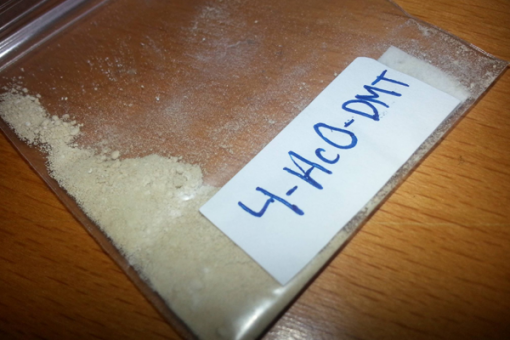
4-AcO-DMT (4-Acetoxy-N,N-Dimethyltryptamine), also known as Psilacetin or O-Acetylpsilocin, is a synthetic tryptamine derivative that has been referenced in scientific literature involving analytical chemistry, receptor-binding studies, metabolic research, and compound characterization. The compound is structurally related to psilocin and psilocybin and has attracted scientific interest due to its chemical properties and role in research involving tryptamine compounds.
Researchers may investigate 4-AcO-DMT to better understand its chemical structure, analytical characteristics, metabolic conversion pathways, and receptor interactions. Scientific literature frequently references the compound in studies involving tryptamine chemistry, serotonin receptor research, and comparative investigations of related compounds.
What Is 4-AcO-DMT?
4-AcO-DMT is a synthetic tryptamine compound structurally related to psilocin and psilocybin. Scientific literature describes it as an acetylated analogue of psilocin, making it an important reference compound in research involving substituted tryptamines and serotonin receptor interactions.
Researchers may encounter 4-AcO-DMT in studies involving analytical verification, metabolic characterization, receptor-binding investigations, and comparative tryptamine research.
Chemical Structure and Classification of 4-AcO-DMT
4-AcO-DMT belongs to the substituted tryptamine family and is chemically classified as an acetylated derivative of psilocin. Researchers frequently investigate compounds within this chemical class to better understand structural relationships, metabolic pathways, and analytical detection methods.
Its structural similarity to naturally occurring and synthetic tryptamines makes it relevant in comparative research and analytical investigations.
Metabolism and Scientific Interest
One of the most frequently studied aspects of 4-AcO-DMT is its metabolic relationship with psilocin. Scientific literature describes 4-AcO-DMT as a precursor compound that can undergo deacetylation to form psilocin under biological and laboratory conditions.
Researchers may investigate this metabolic conversion as part of broader studies involving tryptamine chemistry, analytical characterization, and compound metabolism.
Recherche sur la liaison aux récepteurs et l'analyse
Scientific investigations have referenced 4-AcO-DMT in studies involving serotonin receptor interactions and receptor-binding analysis. Researchers may evaluate measurable interactions involving serotonin receptor systems as part of laboratory-based research projects.
These investigations contribute to receptor-binding databases, analytical reference materials, and scientific understanding of substituted tryptamines.
Why Researchers Study 4-AcO-DMT
Researchers may reference 4-AcO-DMT in studies involving:
- Chimie analytique
- Recherche sur la tryptamine
- Investigations métaboliques
- Identification du composé
- Caractérisation structurelle
- Études de liaison aux récepteurs
- Analyse comparative des composés
- Documentation scientifique
These studies help improve analytical methodologies and understanding of tryptamine chemistry.
Analytical Characterization of 4-AcO-DMT
Analytical laboratories may use various techniques to identify and characterize 4-AcO-DMT.
Les méthodes analytiques courantes comprennent :
- Chromatographie liquide haute performance (HPLC)
- Chromatographie Liquide-Spectrométrie de Masse (LC-MS)
- Chromatographie en phase gazeuse-spectrométrie de masse (GC-MS)
- Analyse spectroscopique
- Techniques de caractérisation structurale
- Procédures de vérification des composés
Ces méthodes aident les chercheurs à générer des données analytiques fiables et à soutenir les investigations scientifiques.
4-AcO-DMT in Tryptamine Research
Tryptamine compounds represent an important area of modern analytical and chemical research. Researchers studying 4-AcO-DMT may evaluate its structure and properties alongside other tryptamine derivatives to better understand compound classification, metabolism, and analytical behavior.
Such investigations contribute to broader scientific knowledge of substituted tryptamine chemistry.
Composés et analogues associés
Researchers studying 4-AcO-DMT may also encounter:
- Psilocine (4-HO-DMT)
- Psilocybin (4-PO-DMT)
- DMT (N,N-diméthyltryptamine)
- 4-HO-DMT
- Tryptamine Derivatives
- Substituted Indole Compounds
These compounds are frequently referenced in analytical, metabolic, and comparative investigations.
Research Applications of 4-AcO-DMT
Les domaines d'intérêt scientifique potentiels comprennent :
- Analyse chimique
- Vérification analytique
- Metabolic research
- Études de liaison aux récepteurs
- Caractérisation structurelle
- Évaluation des documents de référence
- Développement de méthodes de laboratoire
- Recherche comparative de composés
Considérations relatives au stockage et à la manipulation en laboratoire
Les composés de recherche doivent être conservés dans un récipient frais, sec et hermétiquement fermé, à l'abri de la lumière directe du soleil, de l'humidité et des températures excessives. Le respect des procédures de manipulation et de documentation en laboratoire contribue à préserver l'intégrité des échantillons et à garantir la fiabilité des résultats analytiques.
Toutes les activités de recherche doivent être menées conformément aux réglementations applicables, aux protocoles de laboratoire et aux exigences institutionnelles.
Foire aux questions
What is 4-AcO-DMT?
4-AcO-DMT (4-Acetoxy-N,N-Dimethyltryptamine) is a synthetic tryptamine derivative and acetylated analogue of psilocin referenced in scientific and analytical research.
What are the alternative names of 4-AcO-DMT?
Alternative names include Psilacetin, O-Acetylpsilocin, Acetylpsilocin, 4-Acetoxy-DMT, and PSOA.
What is the molecular formula of 4-AcO-DMT?
The molecular formula of 4-AcO-DMT is C14H18N2O2.
What is the CAS number of 4-AcO-DMT?
The CAS number of 4-AcO-DMT is 92292-84-7.
What research fields study 4-AcO-DMT?
Research may involve analytical chemistry, tryptamine investigations, metabolic studies, receptor-binding research, and compound characterization.
Which analytical methods are commonly used to study 4-AcO-DMT?
Les chercheurs peuvent utiliser la CLHP, la LC-MS, la GC-MS, la spectroscopie et d'autres techniques analytiques pour l'identification et la caractérisation des composés.
Why is 4-AcO-DMT important in scientific research?
It is referenced in scientific literature because of its structural relationship to psilocin and psilocybin, as well as its relevance to metabolic and analytical investigations.
What compounds are related to 4-AcO-DMT?
Related compounds include Psilocin, Psilocybin, DMT, 4-HO-DMT, and other substituted tryptamine derivatives.
Avis de non-responsabilité en matière d'éducation et de recherche
This page is provided for educational, scientific, and informational purposes only. Information regarding 4-AcO-DMT is intended to support academic discussion, scientific understanding, and research reference activities. Any research involving this compound should be conducted by qualified professionals in accordance with applicable laws, regulations, institutional policies, and laboratory safety standards.


 English
 Español
 Français
 Português
 Deutsch